DFScarbonwheels
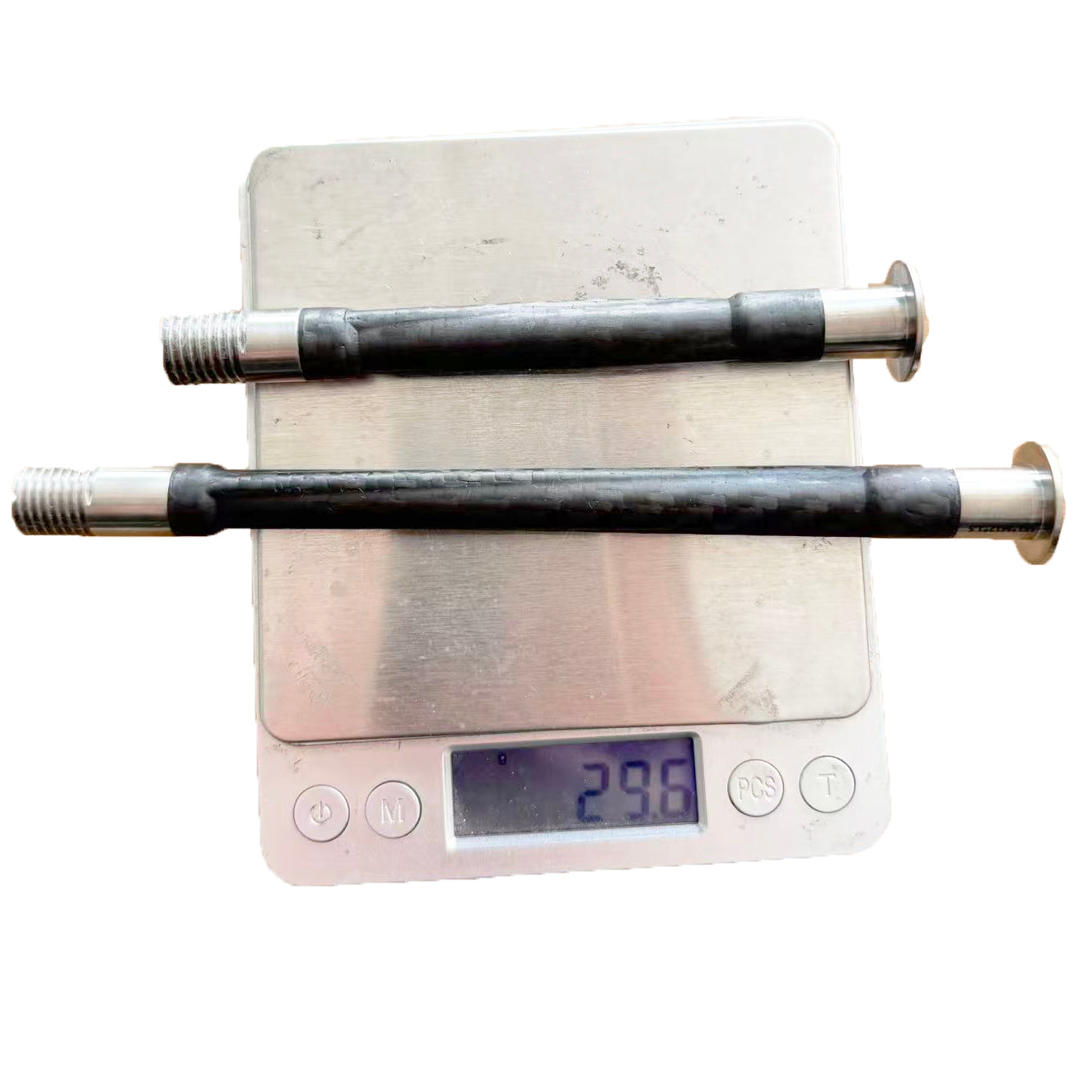
DFS Carbon Thru Axle Road Bicycle Wheel Ultralight 30g Compatible Carbon Fiber Frame Customized by length
DFS Carbon Thru Axle Road Bicycle Wheel Ultralight 30g Compatible Carbon Fiber Frame Customized by length
Couldn't load pickup availability
Carbon fiber thru-axles are critical components that connect the fork to the frame on bicycles, particularly high-performance models such as road bikes and mountain bikes. Compared to traditional metal axles (such as aluminum alloy or steel), carbon fiber thru-axles offer the following significant advantages:
-
Lightweight
Low density of carbon fiber material: With a density of approximately 1.6 g/cm³, carbon fiber is significantly lighter than aluminum alloy (2.7 g/cm³) or steel (7.8 g/cm³). This greatly reduces component weight. A pair of carbon fiber thru-axles is typically 30% to 50% lighter than their metal counterparts, contributing to overall weight reduction—especially in rotational components—and improving handling agility. -
High Strength and Stiffness
High specific strength/specific modulus: Through specialized weaving and resin curing, carbon fiber structures can be optimized for directional stress, delivering excellent tensile and compressive performance while maintaining high strength. Carbon fiber thru-axles can withstand higher longitudinal tension (clamping force) and lateral shear forces, reducing the risk of deformation.
Stable preload retention: High rigidity helps maintain the clamping preload between the wheel and the frame/fork, preventing loosening after repeated bumps. -
Vibration Damping and Comfort
Material damping characteristics: Carbon fiber possesses certain vibration-absorbing properties, which filter out fine road vibrations and reduce impacts transmitted to the frame. This enhances riding comfort, especially during long-distance rides or on rough surfaces. -
Corrosion Resistance
Chemical corrosion resistance: Carbon fiber is not easily corroded by rain, sweat, or cleaning agents, eliminating concerns about rust commonly associated with metal axles and extending service life. -
Design Integration
Aerodynamic and aesthetic optimization: Carbon fiber can be easily molded into streamlined or custom shapes, allowing it to align with the design language of the frame and fork while reducing air turbulence (especially on disc-brake road bikes). Many high-end models feature hidden or integrated axle designs, enhancing visual cohesiveness. -
Temperature Stability
Low thermal expansion: Carbon fiber has a much lower coefficient of thermal expansion than metals, maintaining dimensional stability under extreme temperatures (such as during mountain descents or exposure to intense sun). This prevents changes in preload due to thermal expansion or contraction.
Applicable Scenarios
-
Competitive bicycles: Road bikes, mountain bikes, and gravel bikes that prioritize ultimate lightness and performance.
-
High-end production bikes or aftermarket upgrades: Commonly found in premium models from brands like Specialized, Trek, and Canyon, or as aftermarket upgrade components (e.g., from Carbon-Ti, KCNC).
Summary
Carbon fiber thru-axles achieve a balance of lightweight construction, high stiffness, vibration damping, and corrosion resistance through material advantages, making them an ideal choice for high-performance bicycles. However, due to their higher cost and installation requirements, they are best suited for riders focused on performance improvement and with sufficient budgets. For everyday riding with moderate intensity, metal axles remain a reliable and economical option.